 Português
 Deutsch
 English
 Français
 Italiano
 Español
 Nederlands
 Svenska
Quevedo vs Podoroska: Two First-Time Finalists in São Paulo
Both Kaitlin Quevedo and Nadia Podoroska appear in a WTA final for the first time as São Paulo clay hosts Monday's title match between Spain and Argentina.

A Final Without a Roadmap: Neither Player Has Been Here Before
When Kaitlin Quevedo and Nadia Podoroska walk onto the São Paulo clay for Monday's SP Open final, both players will be entering completely uncharted territory. Neither has appeared in a WTA singles final before; neither knows what it feels like to stand two sets from a title at this level. What the Palácio dos Esportes will witness this afternoon is two career trajectories arriving at the same crossroads simultaneously — a convergence that makes this one of the more compelling WTA finals in recent memory on the South American clay swing.
Quevedo: Spain's New Standard-Bearer Comes of Age
Kaitlin Quevedo, 22, entered the week in São Paulo knowing the surface suited her game. Her patient, physically demanding baseline style extracts the maximum from slow clay, and the draw opened up at exactly the right moment for a player who has been knocking on the door of the WTA's elite tier. She reached the final by defeating Anna Blinkova in three sets, 6-4, 2-6, 6-4, in a semifinal that tested her composure precisely as a final will: Blinkova took the second set convincingly, broke the Spaniard's rhythm, and made the third a genuine contest before Quevedo regrouped and closed with purpose.
The response in that deciding set told everything about what kind of competitor Quevedo is. She did not chase the lost set. She reset, trusted her patterns, and wore her opponent down over the course of an hour. Her game on clay is built around exceptional return depth, strong defensive coverage, and the ability to manufacture angles when rallies extend. None of those qualities become liabilities on this surface. The question is whether they will be enough against a player whose experience advantage is substantial and whose big-match record, at grand slam level at least, is considerable.
Podoroska: The 29-Year-Old With Nothing Left to Prove Except This
Nadia Podoroska was not the tournament favourite coming into her semifinal against Paula Badosa. The Spaniard had been playing with the conviction of someone who believed the title was hers to lose. Podoroska dismantled that conviction efficiently, winning 6-3, 6-4 in a match that was never as close as the scoreline suggests. The Argentine went after her shots from the first game, denied Badosa the rhythm she needed to build points, and closed out with the composed confidence of a player who rises when others expect her to shrink.
At 29, Podoroska brings to this final the scar tissue of a career spent fighting into draws as a qualifier, most memorably at Roland Garros 2020 when she reached the semifinals without ever having been seeded — one of the more improbable runs in recent grand slam history. The WTA final is a stage she has not stood on before, but it is not a stage that will intimidate a player who has always found her best tennis in the moments that matter most. Managing the specific nerves of a first final is a different challenge, however, and it is one she shares with her opponent.
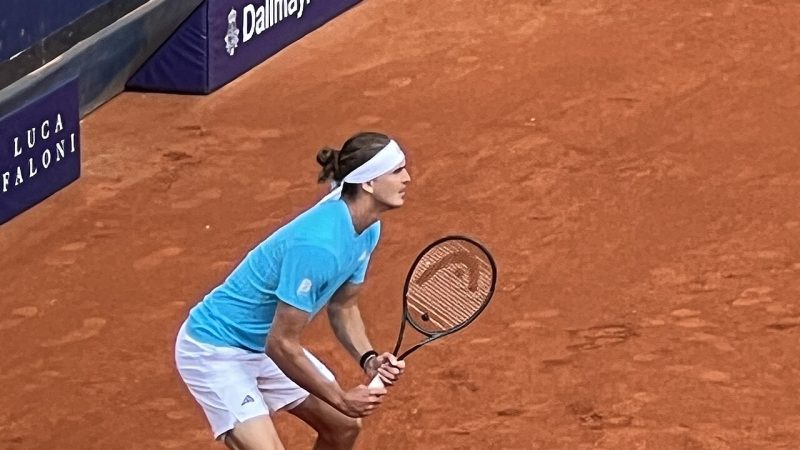
 Zverev outhits De Minaur to reach first Shanghai semi-final since 2019
Clay, Patience, and One First Title
Quevedo has the surface advantage in the sense that clay is where she has built every meaningful result of her career. Podoroska has the edge in match experience at the highest level and a demonstrated ability to play through pressure points without flinching. Neither has a reference point for how she performs specifically in a WTA final, because neither has been there. The São Paulo trophy goes to the player who handles that shared inexperience better than her opponent — and on this particular clay, where rallies run long and points require sustained intensity to win, both finalists have the tools to go the distance and claim it.
Escolhas da redação
- 1
- 2
- 3
- 4
- 5
Wuhan loses top two seeds: Li stuns Sabalenka, Ostapenko ousts Pegula
Ann Li needed ten match points to beat three-time champion Aryna Sabalenka, while Jeļena Ostapenko saved three to knock out Jessica Pegula. Shnaider then beat Muchová.
The Wuhan Open has lost both of its top seeds before the last 16. On Wednesday, Ann Li beat No. 1 seed Aryna Sabalenka 3-6, 6-4, 7-6(5) on her tenth match point. Earlier the same day, Jeļena Ostapenko saved three match points and beat No. 2 seed Jessica Pegula 2-6, 7-6(7), 6-3.

.jpg)