 English
 Deutsch
 Français
 Italiano
 Español
 Português
 Nederlands
 Svenska
Badosa Faces Hamburg Test After Iasi Racket-Throw Backlash
Paula Badosa is under fire after throwing her racket into the stands at the Iași Open semi-final and retiring in the final. She now faces Katarzyna Kawa in the WTA Hamburg round of 16 with fitness and reputation both und

The Incident That Ignited the Debate
Paula Badosa arrived at the MSC Hamburg Ladies Open on Wednesday carrying a weight beyond physical fatigue. The former world number two is scheduled to face Poland's Katarzyna Kawa in the round of 16, but the dominant conversation around her in the past 48 hours has had nothing to do with Hamburg and everything to do with what happened in Romania.
During her semi-final at the Iași Open against Tamara Zidansek, Badosa launched her racket into the stands after missing an overhead smash. The racket flew toward the crowd and narrowly missed spectators sitting in the front rows. Chair umpire officials declined to disqualify the Spanish player, and she went on to win the semi-final and advance to the final.
The decision prompted an immediate and vocal reaction from figures within the game. Rennae Stubbs, a four-time Grand Slam doubles champion and former coach of Serena Williams, addressed the incident on her podcast with blunt language. "That was an absolute disgrace," Stubbs said. "As a player, when you let go of a racket out of your hand, whatever happens after that is on you. You had the control of the racket in your hand, and you let it go. Automatic default." Stubbs argued that any racket that enters the stands should result in an immediate disqualification without exception, regardless of whether spectators are struck.
Retirement in the Final and a Public Apology
The story developed further days later when Badosa was forced to retire from the Iași final against Mayar Sherif, trailing 6–4, 4–0. The Spaniard had played ten matches across the previous two weeks and said her body simply could not continue. Sherif claimed the Iași title by default, ending a four-year drought without a WTA trophy.
Badosa subsequently issued a public statement. "I hate this moment. I'm really sorry," she said, directing her apology at the spectators and the tournament organisation in Romania.
The racket throw drew no official sanction beyond what was applied on court, but the reaction from commentators and former players has been sustained. Multiple voices in the tennis world have argued in the days since that the rulebook offers clarity on this point and that officials should apply it consistently when an implement leaves the playing area toward spectators.
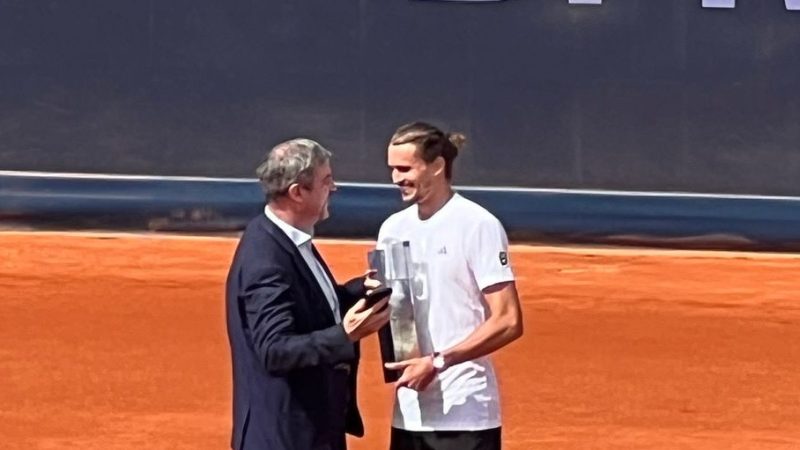 Zverev outhits De Minaur to reach first Shanghai semi-final since 2019
Hamburg: Questions of Fitness and Form
The round of 16 tie against Kawa places two further questions in front of Badosa. The first is physical: having retired in a WTA final less than 48 hours earlier, can she compete to the level required to progress at a clay-court WTA 250? Her run to the Iași final — nine consecutive wins before the retirement — demonstrated that her tennis, when her body cooperates, remains a match for most opponents. But the pattern of breakdown after sustained effort has repeated itself throughout her career.
The second question concerns the racket-throw debate itself. Kawa is an experienced clay-court operator who will not be distracted by external narratives, but Badosa steps onto the Rothenbaum surface with more than just a match to win. Second seed Anhelina Kalinina and top seed Oleksandra Oliynykova represent the standard she would need to reach to contend for the Hamburg title. Whether she is in a physical condition to do so will become clearer from her opening exchanges against Kawa on Wednesday.
The broader debate about racket safety and officiating standards is unlikely to be resolved this week. What Wednesday will settle, at least partially, is whether Badosa's body has recovered enough to play competitive tennis.
Editors' picks
- 1
- 2
- 3
- 4
- 5
Wuhan loses top two seeds: Li stuns Sabalenka, Ostapenko ousts Pegula
Ann Li needed ten match points to beat three-time champion Aryna Sabalenka, while Jeļena Ostapenko saved three to knock out Jessica Pegula. Shnaider then beat Muchová.
The Wuhan Open has lost both of its top seeds before the last 16. On Wednesday, Ann Li beat No. 1 seed Aryna Sabalenka 3-6, 6-4, 7-6(5) on her tenth match point. Earlier the same day, Jeļena Ostapenko saved three match points and beat No. 2 seed Jessica Pegula 2-6, 7-6(7), 6-3.

_04_(cropped).jpg)